

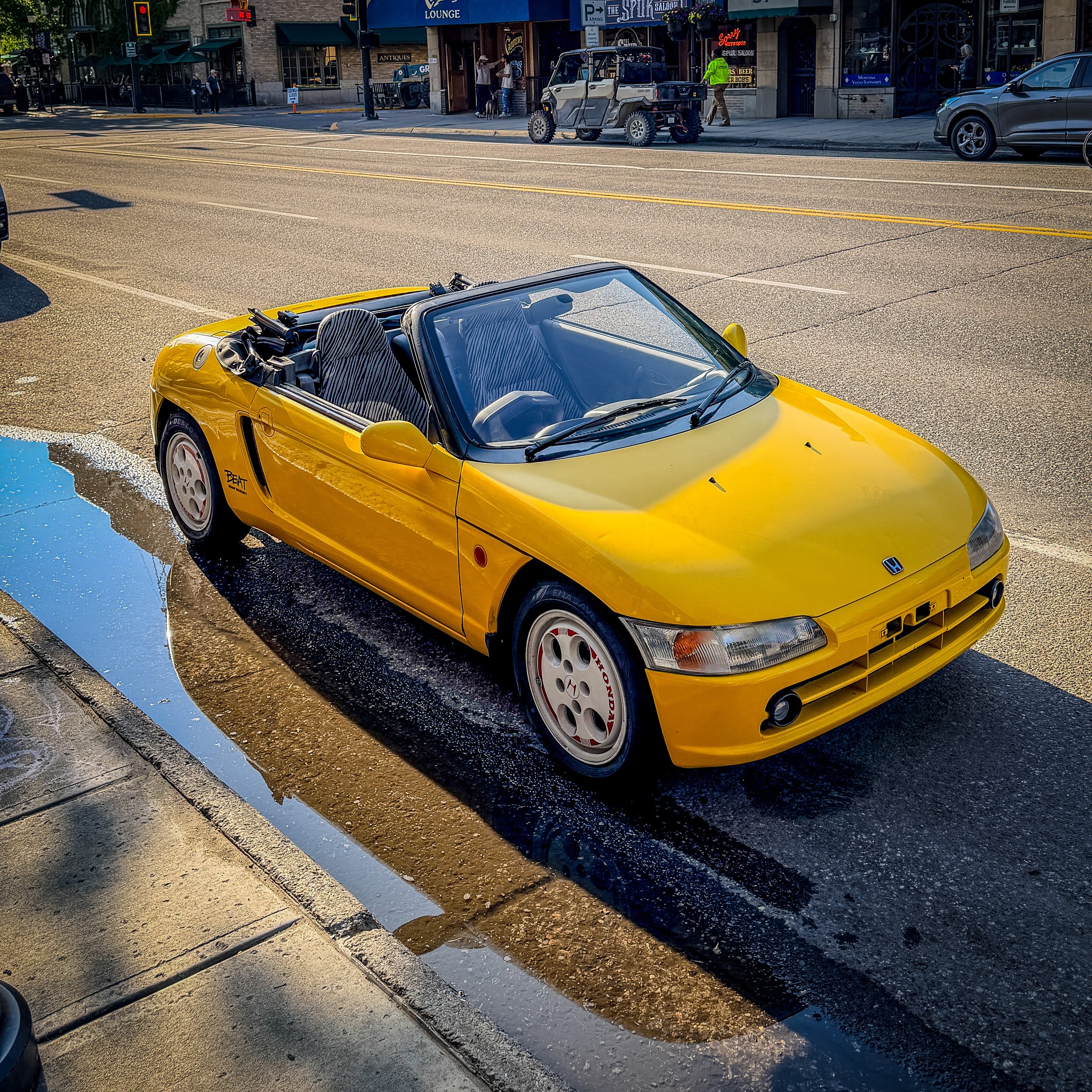
Honda Beat.
A 656cc, mid-engine, rear-drive roadster built around one wonderfully unreasonable idea: small cars should be a riot.
Fast facts.
Original Japanese-market launch specifications. Tiny dimensions, serious engineering, zero wasted motion.
Honda built the fun first.
Honda introduced the Beat in May 1991 as what it called a “midship amusement” machine: a full-open two-seater designed to make seeing, driving and controlling a car feel joyful.
It used Japan’s kei-car limits as a creative brief rather than an excuse. The engine sat behind the seats, the rear wheels did the driving, the roof folded by hand, and the only transmission was a five-speed manual.
The Beat stayed in production through 1996 and was sold new in Japan. It is widely described as the final production car personally approved by Honda founder Soichiro Honda before his death in 1991.
Not a shrunken supercar. A purpose-built joy machine.
Why it matters.
The spec sheet is funny. The engineering underneath it is not.
Mid-engine balance
The E07A sits ahead of the rear axle, placing the mechanical noise directly behind the cabin and giving the Beat the proportions and responses of a miniature sports car.
Three throttles
MTREC gives the three-cylinder engine an individual throttle body for each cylinder. The result is sharp response and an induction sound wildly out of proportion to the horsepower.
Built to be worked
Staggered wheel sizes, four-wheel disc brakes, MacPherson struts at both ends and a high-revving naturally aspirated engine make the entire car feel intentional.
Multi Throttle Responsive Engine Control is Honda’s intake and engine-management setup for the Beat. Each of the E07A’s three cylinders gets its own throttle body.
There is no turbocharger hiding the lack of displacement. The engine makes its power by breathing cleanly, responding immediately and spinning hard: peak output arrives at 8,100 rpm, and the tach keeps going to an 8,500 rpm redline.
Translation: 64 PS has never sounded this heroic.
Slow car.
Fast experience.
The Beat’s speed is not the headline. Access to the whole car is.
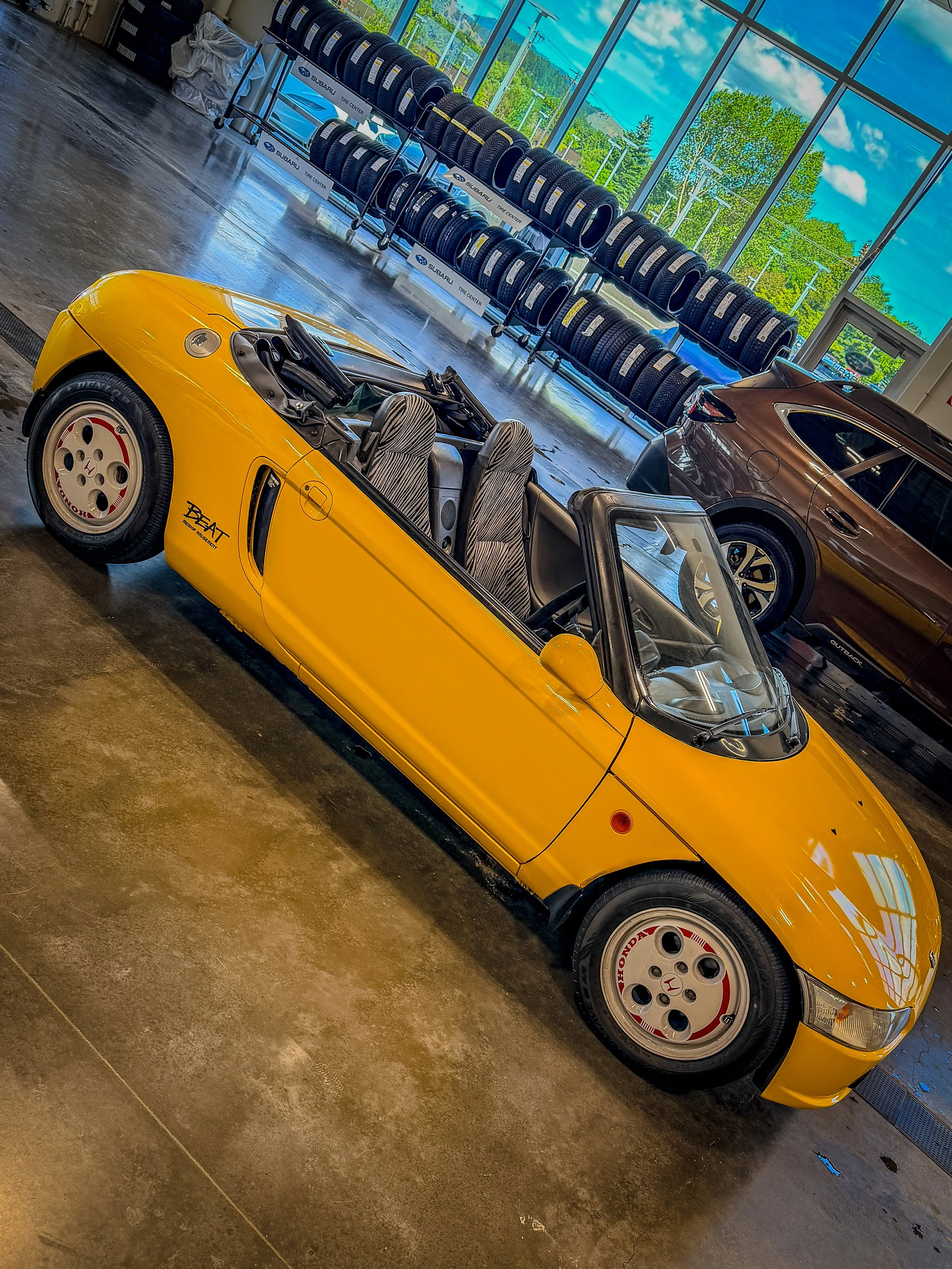
Use all of it.
The Beat is a clean expression of the “slow car fast” idea. Its modest power lets the driver stay in the throttle, use the five-speed gearbox and explore the upper half of the tach without immediately arriving at deeply antisocial speeds.
There is no modern layer of screens, drive modes or artificial sound between the driver and the machine. The steering, short gearing, intake noise, open roof and tiny footprint are the experience.
It fits in the shadow of an 80 Series and makes twice the commotion.
Living with a Beat.
A general starting point—not a substitute for a proper pre-purchase inspection or the Honda workshop manual.
Service history
Confirm timing-belt, water-pump, fluid and ignition-service history. Age matters as much as mileage on a 1990s import.
Cooling system
Look for leaks, overheating history and evidence that the mid-engine cooling system has been filled and bled correctly.
Main relay & ignition
Intermittent no-start problems can involve the main relay, fuel delivery, distributor or aging wiring. Diagnose before throwing parts at it.
Water intrusion
Inspect the soft top, rear window, drains, door membranes, carpets, trunk and seams for leaks, dampness and corrosion.
Engine access
Routine work is different from a front-engine car. The main service opening is behind the seats, with additional access through the rear luggage area.
Parts planning
The Beat was never sold new in the United States. Verify parts availability, shipping time and interchange before assuming a repair will be quick.
Body & roof condition
Check panel fit, accident repairs, underbody corrosion, roof fabric, seals and rear-window condition. Cosmetic pieces can be harder to source than mechanical consumables.
Keep it stock-ish
Intake, exhaust, wheels and steering wheels are common changes. Favor reversible work and keep original parts when possible.
Specifications and service notes can vary by chassis series, production date and prior modification. Verify procedures, capacities, torque values and parts against the factory manual and the individual car.
Aaron’s Beat.
1991 Honda Beat PP1 · Carnival Yellow · zebra interior · five-speed manual.

Sources & next stops.
Start with Honda’s original specifications, then get the loud version from AGF.