

It made everything else look heavy: a love letter to a blue Caterham Seven 360
She got four sentences in the Ressler Cars & Coffee recap, wedged between a liveried Subaru and a very good dog. Here's the apology, in full.
A Correction, Of Sorts
I called it the coolest thing on the lot and then gave it four sentences. That was never going to hold.
Back in the Ressler Cars & Coffee recap I wrote that a blue Caterham Super Seven made "a Miata look like a luxury sedan," called it the purest idea in the entire automotive world, and moved on to a dog named Boone like a man with no sense of priorities. That was a mistake I've been meaning to fix since the moment I filed it. Some cars share a paragraph with a Subaru wrapped in anime characters. This one gets its own post.
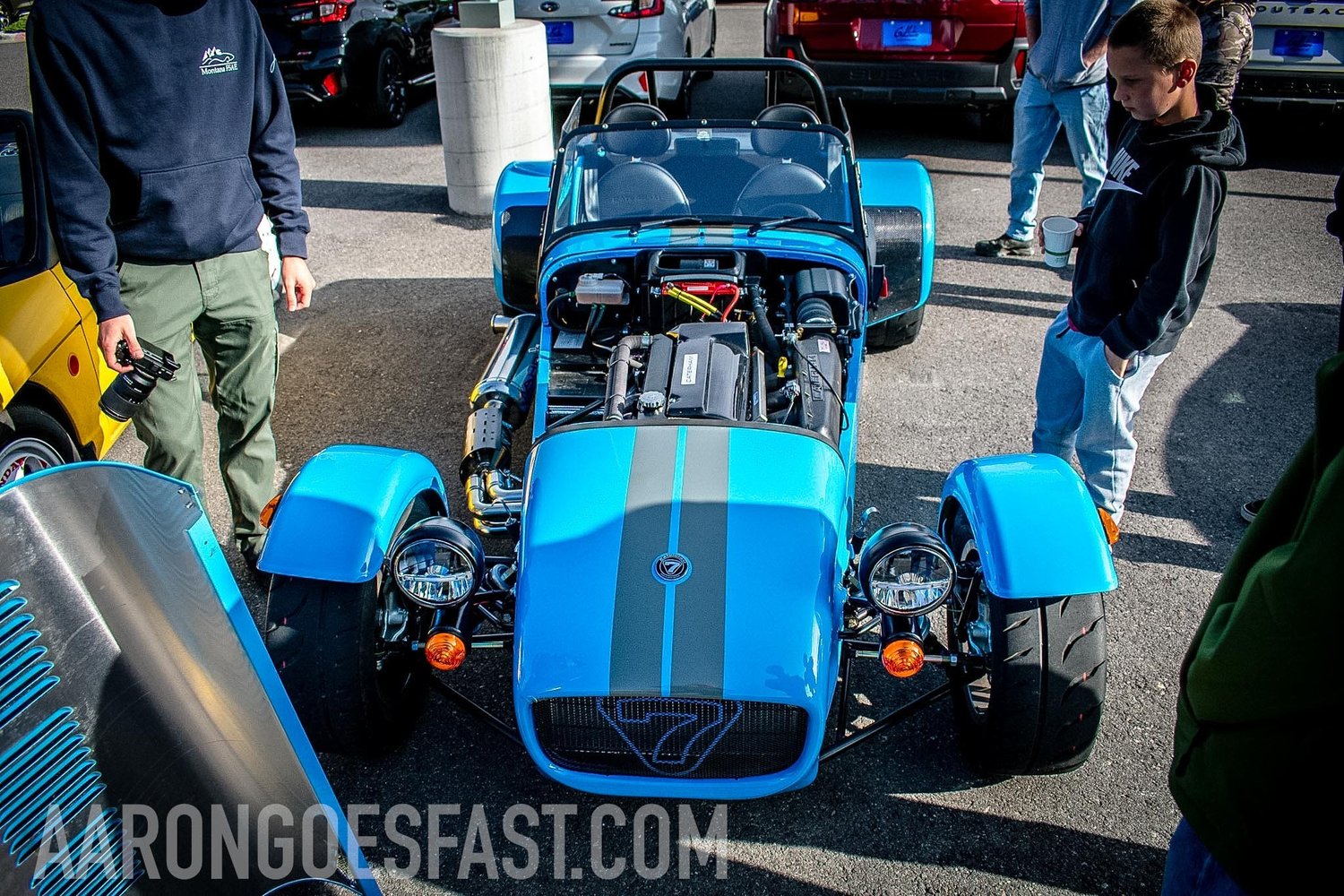
It was sitting low and blue near the front of the lot, fenders barely clearing the tires, nothing between the driver and the engine bay but a curved sheet of aluminum — and somebody had it up on jack stands mid-fettle, cycling the front suspension by hand while a small crowd asked it questions. I walked past a parking lot full of six-figure German engineering to keep coming back to it. More than twice.
What It Actually Is (And What It Isn't)
Somebody at the show told me it had a Miata motor under that hood. Great story. Wrong car.
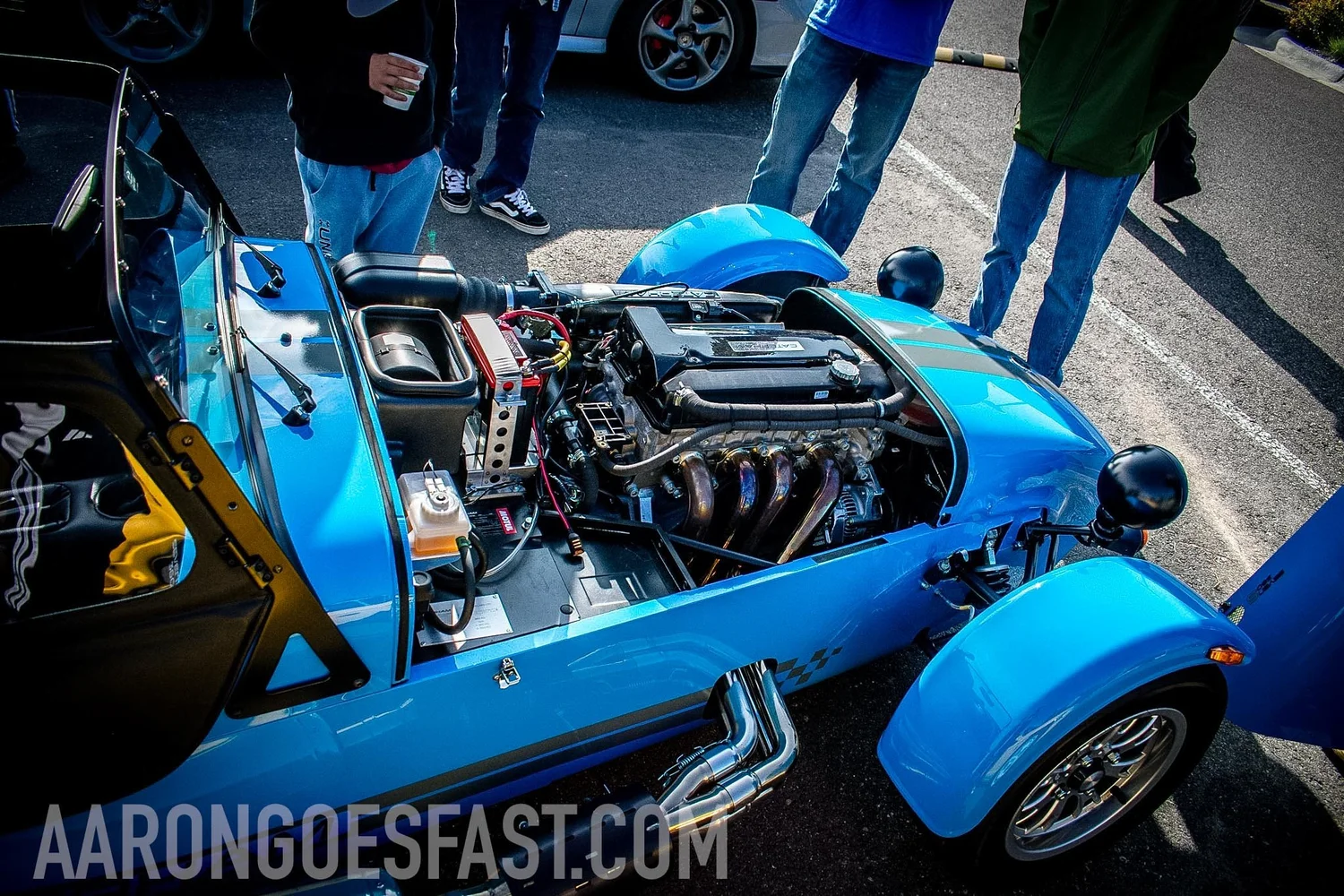
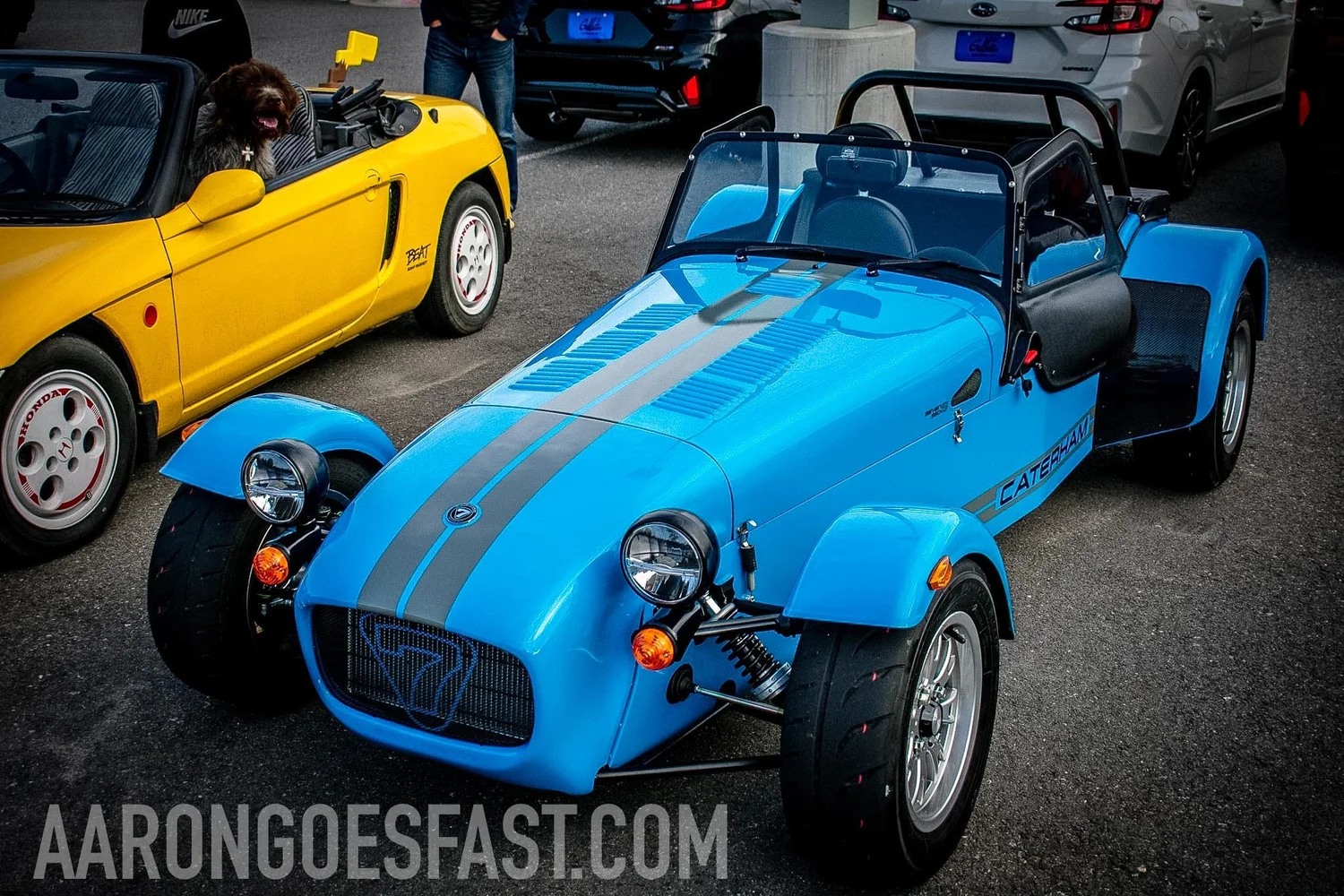
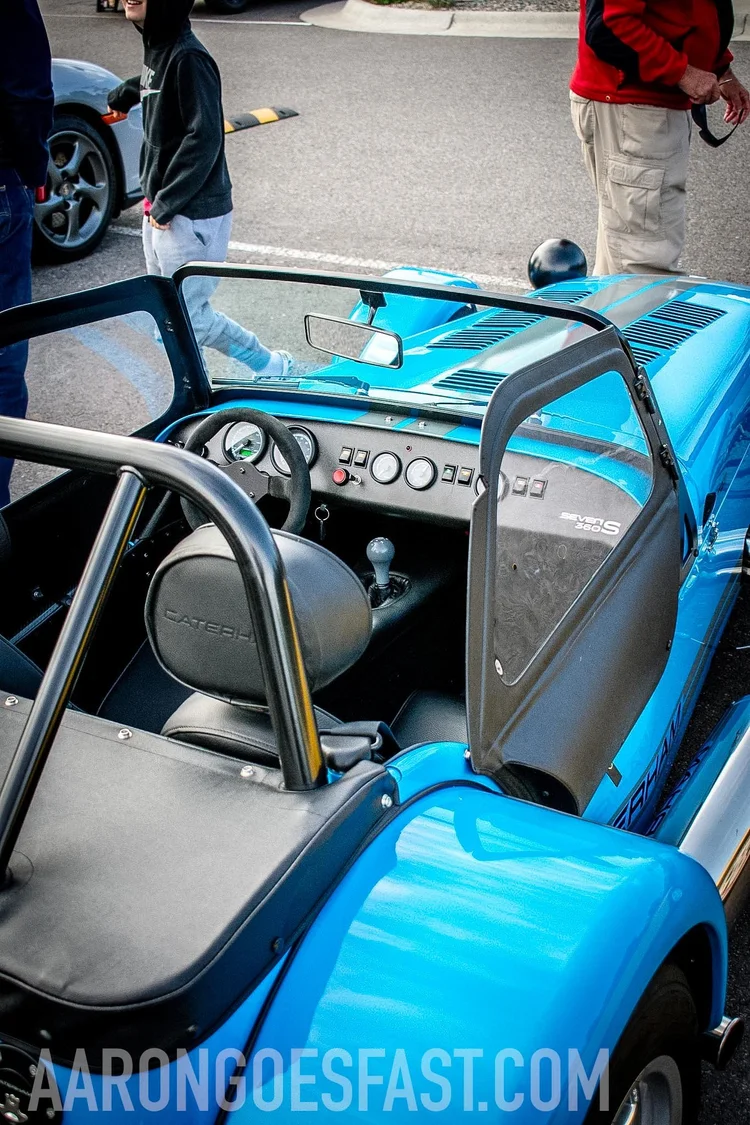
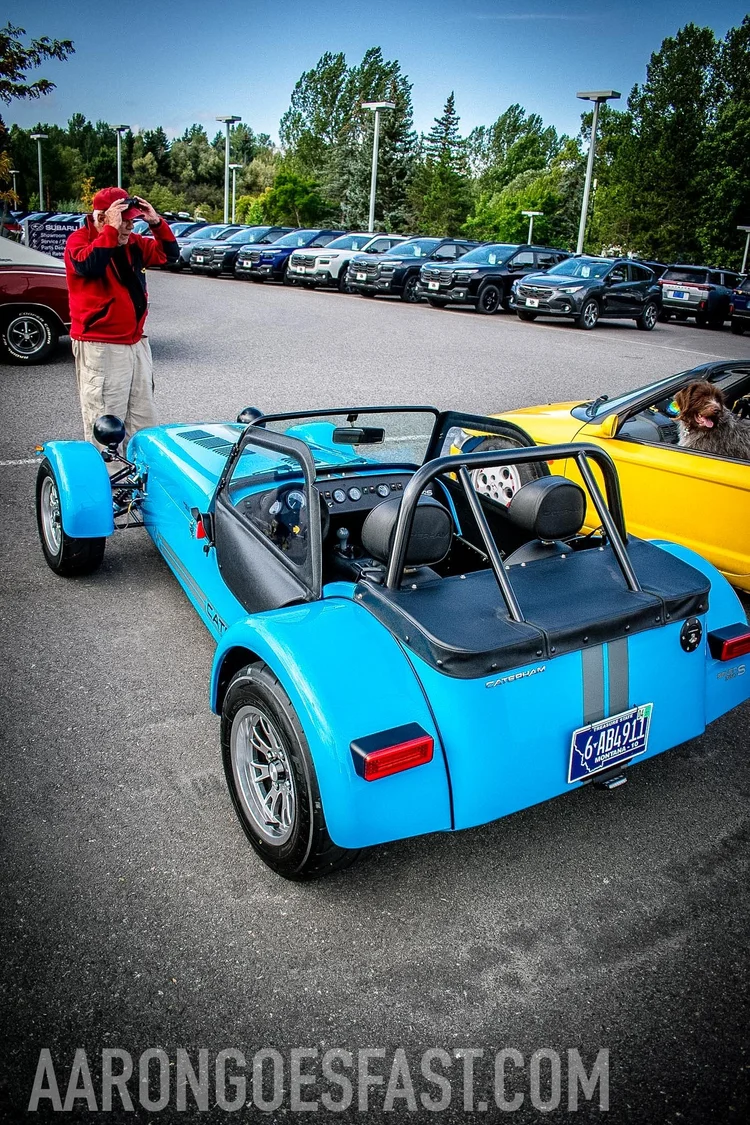
I heard the same thing standing in that parking lot — Miata engine, kit car, the whole story. It's an easy mistake to make; half the Seven-shaped cars in existence really do run on Mazda running gear, because a Miata donor is cheap, light, and everywhere. But this one isn't one of those. The flank reads Caterham in script, the nose wears the brand's "7" roundel dead center in the grille, and the dash badge next to the passenger's knee spells it out plainly: Seven S 360. This is a genuine, factory Caterham — built in Surrey, England, on a lineage that traces straight back to Colin Chapman's original 1957 Lotus Seven.
The "360" isn't a displacement or a trim year, it's Caterham's own shorthand for power-to-weight — roughly how many horsepower you're getting per metric tonne. Under that hood sits a 2.0-liter Ford Duratec four, good for about 180 horsepower at a screaming 7,300 rpm and 143 lb-ft of torque, backed by a 5-speed manual sending everything to a De Dion rear axle. No Miata anywhere in the chain.
What I'm Working With Here
- Model: Caterham Seven S 360
- Engine: 2.0L Ford Duratec inline-4, naturally aspirated
- Output: ~180 hp @ 7,300 rpm, 143 lb-ft @ 6,100 rpm
- Transmission: 5-speed manual, rear-wheel drive, De Dion rear axle
- Weight: roughly 1,100–1,235 lb depending on spec
- 0–60 mph: right around 4.8 seconds
- Character: four wheels, an engine, and the smallest possible amount of everything else
The Beat is my version of this idea. The Super Seven is the original — the car my yellow kei roadster has been quietly cosplaying as this entire time.
The Math That Makes This Thing Work
180 horsepower doesn't sound like much until you find out what it's pushing.
180 horsepower is a rounding error in a modern crossover. In a car that weighs about as much as a golf cart with delusions of grandeur, it's a different conversation entirely. That's the whole Lotus-to-Caterham philosophy in one sentence — Colin Chapman's "simplify, then add lightness" wasn't a slogan, it was a build sheet, and seventy years later this thing is still following it to the letter. No doors, no roof, no sound deadening, no argument.
Take a car this light, drop a high-revving four in front of the driver's knees, strip out anything that isn't structural, and point it at an autocross course. There isn't a more honest argument for why the Seven has been an SCCA Solo favorite for decades — no doors to worry about clipping a pylon, a footprint narrow enough to thread gaps a full-size car wouldn't consider, and a driving position so close to the pavement you feel every ounce of body roll before it happens, which, in a car this stiff, isn't much. It wouldn't just be quick around a cone course. It would be a genuinely stupid amount of fun doing it.
The Blue
Not navy, not teal, not anything a paint chip could make sound boring.
I'll admit the spec sheet is only half of why I kept walking back over. That blue is doing serious work — bright, saturated, closer to a race livery than a factory color card, with a cool gray stripe running dead-center over the nose and hood like it was applied with a straightedge and zero hesitation. It's the kind of color that makes a car look faster parked than most cars look moving, and on a shape this small and this uncluttered, there's nowhere for it to hide. Blue Montana plate on the back, same shade of confidence up front. I'd have picked this exact color off the swatch myself.
The Verdict
Real Caterham, real Duratec, real easy to fall for. No Miata required.
I came back to a recap I'd already published just to give one car the paragraphs it earned. A blue Caterham Seven 360 being wrenched on in a Montana dealership parking lot, badge-verified and Duratec-powered, is still the single coolest thing I've photographed at a cars-and-coffee all year. Somebody's autocross season is about to get a lot more interesting. I just hope they let me shoot it.
