

Read this before buying 64 horsepower of Japanese chaos.
So You Think You Want a Honda Beat
You absolutely do.
The Honda Beat is a 656cc, mid-engine, rear-drive, five-speed kei roadster with individual throttle bodies, an 8,500 rpm redline and absolutely no interest in behaving like transportation.
It is also a thirty-plus-year-old, Japan-only Honda whose engine is located directly behind your spine and whose replacement parts may currently be asleep somewhere in Osaka.
This One Is Personal
Unlike several of the Land Cruiser guides, this one is built around a car that actually lives in the AGF garage.
Aaron’s Beat is a 1991 PP1 in Carnival Yellow with the glorious zebra interior and the only transmission Honda offered: a five-speed manual.
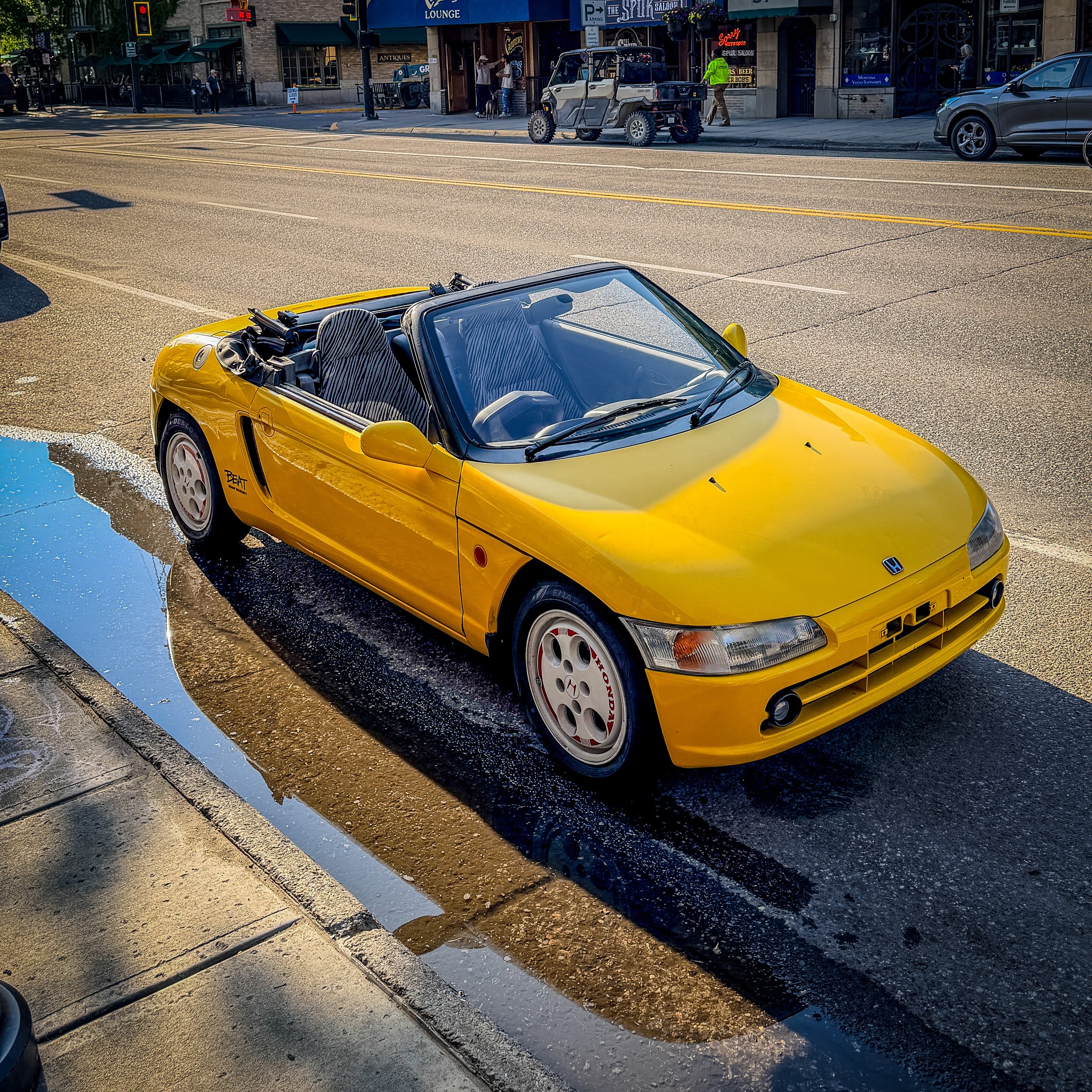
Honda Beat Basics
Honda launched the Beat in 1991 as a purpose-built mid-engine kei sports car.
Every Beat uses the PP1 platform, the naturally aspirated E07A inline-three and a five-speed manual transmission.
E07A MTREC
656cc, SOHC, 12 valves, PGM-FI and one throttle body for each cylinder.
Peak output is 64 PS at 8,100 rpm.
Mid-Engine · Rear Drive
The engine sits behind the seats and drives the rear wheels.
Weight distribution and tiny dimensions matter far more than the horsepower number.
Five-Speed Only
There was no automatic Beat.
If somebody claims otherwise, they are selling you a different problem.
Independent All Around
MacPherson struts front and rear with four-wheel disc brakes.
Staggered 13 / 14
155/65R13 front.
165/60R14 rear.
Factory-size tire availability in the U.S. deserves planning.
Manual Soft Top
No motors. No hydraulics. No excuses.
Fold it yourself and check the seals while you are there.
PP1-100 · PP1-110 · Special Editions
PP1-100
The original and most common Beat.
- E07A MTREC engine.
- Five-speed manual.
- Power windows.
- Air conditioning commonly fitted.
- Steel “pepperpot” wheels on standard cars.
- Zebra-pattern interior on normal production cars.
PP1-110
Later production introduced small mechanical and specification changes.
- Same E07A and five-speed layout.
- Limited-slip differential availability.
- ABS availability.
- Later special-edition equipment.
Because equipment can vary, confirm the actual chassis number and what is physically fitted.
Version F
Aztec Green Pearl with distinctive factory equipment and wheels.
Only 800 were produced.
Version C
Captiva Blue Pearl with white alloy wheels.
Only 500 were produced.
Version Z
A later PP1-110-based special version offered in Blade Silver and Everglade Green Metallic.
Later instrumentation and additional equipment distinguish these cars.
Buy Condition Before Version
A dry, well-maintained standard PP1-100 is a better car than a rare special edition with a dead ECU, rotted timing belt and rusty sills.
What Beat Owners Keep Telling Buyers to Check
No IH8MUD here.
This section is built from Beat-specific owner communities, Honda information and recurring PP1 buyer discussions.
Timing Belt
If you cannot document the timing belt, assume it needs one.
The E07A is an interference engine.
A failed belt can introduce pistons and valves in a way Honda did not intend.
Do not gamble an increasingly hard-to-source engine to save the cost of a belt service.
Water Pump and Related Service
Because access is not wonderful, timing-belt service is the logical time to inspect or replace the water pump, tensioner, seals and aging coolant components.
ECU Capacitors
Aging capacitors can leak and damage the factory ECU.
Intermittent or difficult hot starts, strange fueling behavior and eventual no-start conditions can point toward ECU trouble.
Inspect whether the ECU has already been rebuilt, repaired or replaced.
Distributor Condition
Beat owners repeatedly recommend inspecting the distributor.
Remove the cap when possible and look for corrosion, contamination, bearing issues and evidence of previous failure.
Mid-Engine Cooling System
Look for leaks, overheating history, old hoses and poor coolant condition.
The system needs to be filled and bled correctly.
Air trapped in a mid-engine cooling circuit is substantially less entertaining than the induction noise.
Rockers and Jacking Points
Inspect the sills carefully, especially around the front and rear jacking areas.
Pay special attention to the overlapping seam near the rear of the door opening and the side intake area.
Rear Wheel Arches
Check the rear arches, inner lips and the places where the body meets the rocker structure.
Surface bubbling can indicate substantially more corrosion inside.
Footwells
Lift carpet.
Inspect where the floor meets the front bulkhead and where the floor joins the side sills.
Water entering through old seals can quietly destroy the floor from inside.
Bottom of the Doors
Roof and door-seal leaks can send water into the doors.
Check drain holes and the complete lower seam.
Front Edge of the Hood
Look for bubbling, paint lift and corrosion on the front edge.
Fuel-Tank Corrosion
Internal tank rust can contaminate the fuel pump, filter and sender.
Ask when the fuel filter was replaced and verify the fuel gauge actually behaves normally.
Soft Top and Rear Window
Inspect the fabric, seams, latches, weatherstripping and rear window.
Then check the carpet, under-seat areas and luggage compartment for evidence of leaks.
Rev the Damn Thing
A Beat is supposed to rev.
The E07A should pull cleanly through the upper rpm range.
A car that refuses to rev properly, misfires badly or noses over early deserves diagnosis.
Smoke During High-RPM Driving and Downshifts
Watch behind the car during hard acceleration and engine braking.
Smoke can indicate worn valve-guide seals, oil-control-ring problems or other internal wear.
Excessive Engine Movement
Aging mounts can significantly affect the way the tiny drivetrain feels.
Inspect them rather than assuming every vibration is just three-cylinder character.
Second and Third Gear
Shift quickly enough during the road test to expose synchro wear.
Listen for grinding, especially when the gearbox is cold.
Gauges and Original Electronics
Verify the tachometer, temperature gauge, fuel gauge and warning lamps.
Old instrument and electrical faults are not unknown.
Air Conditioning
If A/C matters to you, test it before buying.
At minimum, verify the compressor engages.
Japan-only hoses and fittings can turn a minor problem into a parts-sourcing project.
Title and Registration
Verify the Japanese chassis number, import paperwork and current title.
Kei-car registration rules vary by state.
Do not assume a Montana title guarantees easy registration everywhere.
Can You Actually Get the Part?
Some service parts cross over with other Hondas.
Many Beat-specific components do not.
A rare interior trim piece, engine component or body panel may need to come from Japan.
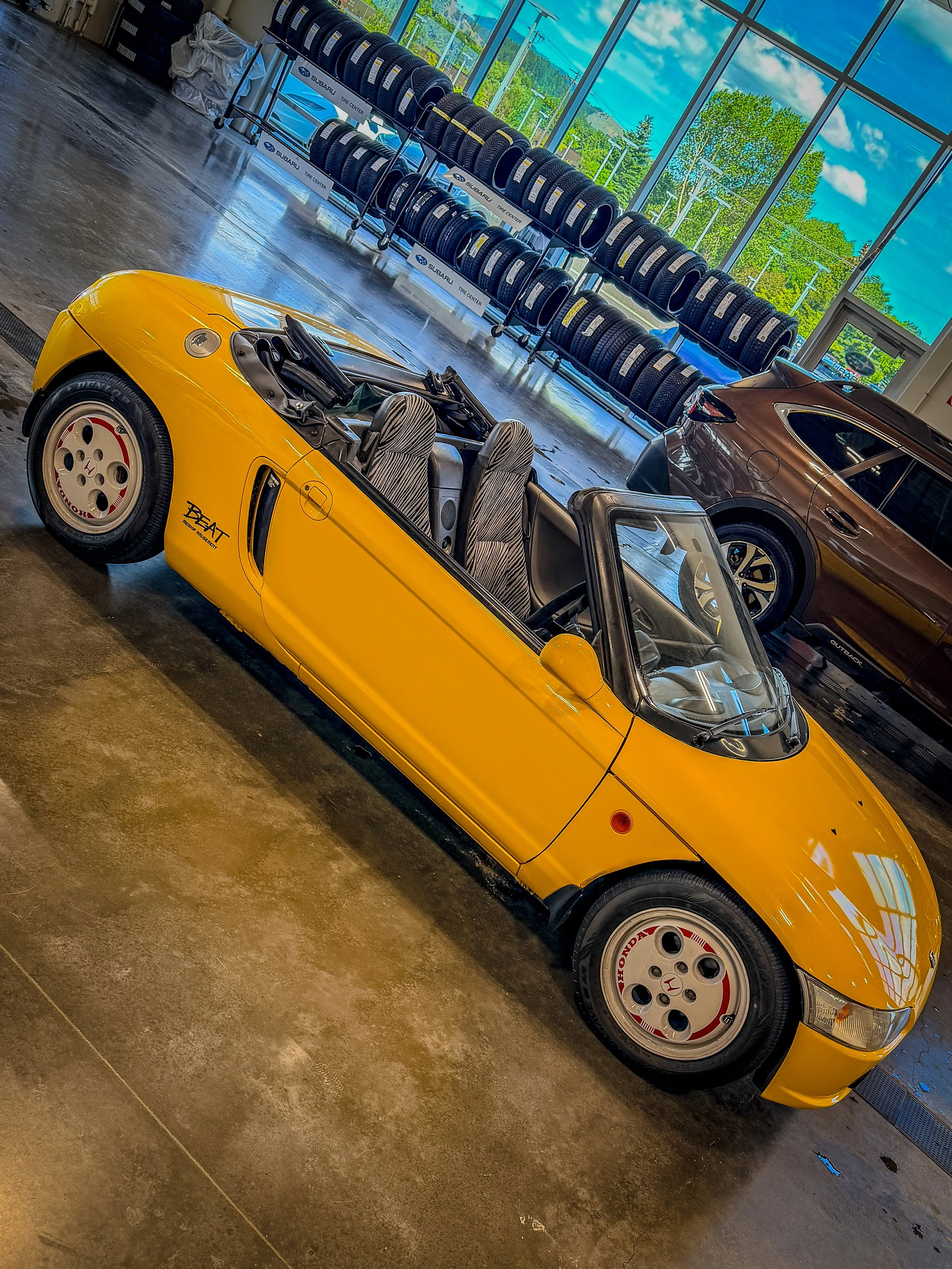
Parts Planning Is Part of Ownership
Consumables
Some filters, spark plugs and basic Honda service parts can be sourced domestically.
Beat-Specific Parts
Ignition components, body trim, interior pieces, engine-specific parts and weatherstripping may require Japan sourcing.
Yahoo Auctions Japan
Used Beat parts remain available in Japan, but proxy purchasing, shipping and patience become part of the ownership experience.
Owner Community
The Honda Beat PP1 US Owners Club & Friends community is repeatedly recommended by American owners for manuals, technical information and parts sourcing.
EtsuRyu / Japan Sources
Beat owners frequently rely on Japan-based parts sourcing when U.S. availability ends.
Buy Spares Before You Need Them
A thirty-dollar part in Japan can still produce a three-week immobilized car.
Plan accordingly.
Walk Away—or Adjust the Price?
Strong Reasons to Walk Away
- Unknown timing belt combined with evidence of engine trouble.
- Severe rocker or floor rust.
- Major accident repair to the monocoque structure.
- Chronic overheating.
- Heavy smoke under load.
- Non-running engine with no diagnosis.
- Severe ECU/wiring damage.
- Missing import/title documentation.
- Badly executed engine swap.
- Seller refuses a genuine road test.
Usually Negotiation or Baseline Items
- Timing belt due but engine otherwise healthy.
- Old water pump and coolant hoses.
- Tired soft top.
- Broken factory radio.
- Inoperative A/C.
- Worn zebra seats.
- Old engine mounts.
- Minor oil seepage.
- Old tires.
- Slow power windows.
- Minor cosmetic rust with solid surrounding metal.
Inspect the Beat, Not the Adorable Face
Baseline Before You Start Buying Carbon Fiber
Timing Belt First
If history is not absolutely convincing, replace the belt.
Cooling System
Water pump, hoses, coolant, thermostat and proper bleeding.
Ignition + ECU
Distributor, plugs, wires, main relay, grounds and ECU health.
Stop the Water
Roof seals, door drains, weatherstripping, footwells and rear storage area.
Suspension + Brakes
Bushings, tie rods, struts, wheel bearings and all four disc brakes.
Then Become Irresponsible
Exhaust, wheels, carbon, body kits and giant racing liveries may now commence.
What Are These Tiny Things Actually Selling For?
Updated September 1, 2026.
Cars & Bids has become especially useful because enough Beats have now sold there to show an actual U.S. driver-market pattern.
| Status | Truck... Sorry, Tiny Honda | Venue | Price / Result | AGF Note |
|---|---|---|---|---|
| Sold | 1992 Honda Beat | Cars & Bids · July 2026 | $6,325 | Modified car with higher mileage. Useful lower-end U.S.-market comparison. |
| Sold | 1991 Carnival Yellow Beat | Cars & Bids · July 2026 | $8,200 | Exactly where many ordinary, usable U.S.-titled Beats continue to trade. |
| Sold | 1991 Festival Red Beat | Cars & Bids · July 2026 | $8,666 | Zebra interior and largely traditional presentation. |
| Sold | 1991 Carnival Yellow Beat | Cars & Bids · June 2026 | $9,100 | 47k miles, Montana title and documented 2025 head, valve, timing-belt and related service. A particularly useful sorted-car benchmark. |
| Sold | 1991 Honda Beat | Cars & Bids · May 2026 | $8,977 | Another data point reinforcing the roughly $8k–$9k normal-driver cluster. |
| Sold | 1991 Honda Beat | Cars & Bids · May 2026 | $8,990 | Yet another nearly $9k result. |
The AGF Honda Beat Wish List
The responsible portion of the buyer guide is now complete.
Welcome to the section where a 64-horsepower kei car becomes an extremely small financial emergency.
Garage Vary Carbon Hood
YES PLEASEReal carbon Beat hood from Garage Vary.
The correct answer to the question “does a 760 kg car really need a carbon hood?” is obviously yes.
See the Carbon Hood ↗Garage Vary Carbon Hardtop
MAXIMUM NONSENSECarbon hardtop for the PP1.
Turns the world’s cutest soft-top roadster into the world’s tiniest carbon-roof sports coupe.
See the Carbon Hardtop ↗Garage Vary Carbon Front Fenders
If we are already ordering the hood from Japan, there is clearly no logical reason to stop there.
Browse Garage Vary Beat Parts ↗US Racing Sports Type R Body Kit
$800 LISTEDThree-piece FRP kit: front bumper, side skirts and rear bumper.
Looks approximately twelve times faster than a stock Beat.
See the Type R Kit ↗US Racing Sports Full Body Kit
$950 LISTEDAnother complete front / side / rear aero setup.
Made in Japan, made to fit eventually, and almost certainly capable of consuming an entire winter.
See the Full Kit ↗Ducks Garden Narrow 997 Beat
Yes.
Somebody in Japan designed a front conversion that makes the Beat resemble a tiny narrow-body Porsche 997.
Front bumper, front fenders, hood and related pieces.
This is objectively ridiculous and therefore extremely important.
See the 997 Beat ↗Back Yard Special Rear Blister Fenders
Back Yard Special still catalogs a wild collection of Beat-specific aero and chassis parts, including rear blister fenders.
Browse Back Yard Special ↗K4-GP / Suzuka Style Livery
The Beat has an enormous Japanese club-racing history.
Think: big numbers, ADVAN graphics, checker patterns, wild sponsor panels, contrasting wheels and absolutely no attempt at subtlety.
A proper AGF Beat livery should look like a 1994 kei endurance racer escaped from Suzuka and accidentally ended up in Montana.

Keep the zebra interior.
Carbon hood.
Carbon hardtop.
Carbon front fenders.
Wild period-Japanese aero.
White or bronze lightweight wheels.
Real suspension.
Good exhaust.
K4-GP-inspired graphics.
No fake turbo noises.
And keep every factory part in the garage because eventually everyone gets nostalgic.
Honda Beat Buyer FAQs
Is the Beat reliable?
Fundamentally, yes.
It is still a 1990s Honda.
But it is also a thirty-plus-year-old Japan-only car.
Timing-belt condition, cooling, ECU health, ignition and rust matter more than the Honda badge.
Is the timing belt really that important?
Yes.
If you cannot document it, replace it.
An E07A is much harder to replace than a timing belt.
Can I daily-drive a Beat?
Yes, but it is better as a second vehicle than your only transportation.
The problem is not necessarily reliability.
The problem is waiting for a Japan-only part while your daily driver occupies half of one parking space.
Will I fit?
Maybe.
Sit in one before buying if possible.
Seat, steering-wheel and pedal changes can improve fit, but the interior is still a kei-car interior.
Are parts impossible?
No.
Some ordinary Honda consumables are easy.
Beat-specific parts require more planning, Japan sourcing and owner-community knowledge.
Should I buy a PP1-110?
Buy it if the later specification, LSD or ABS equipment matters to you.
Do not reject a better PP1-100 solely because of the chassis prefix.
Should I modify one?
Obviously.
Eventually.
Baseline the engine, timing belt, cooling, rust, brakes and suspension first.
Then order the carbon nonsense.
Can I turbocharge it?
People have.
That does not mean a stock E07A with unknown timing-belt history needs boost tomorrow.
The naturally aspirated MTREC character is a major part of what makes the Beat special.
Should I buy the cheapest imported one?
Usually not.
A sorted U.S.-titled car with maintenance records may be cheaper overall than importing a mystery Beat and immediately rebuilding half of it.
Where to Keep Reading
Honda Beat Original Specifications
Honda’s own launch specifications for the PP1, E07A, dimensions, weight, gearbox and performance.
Honda Official Beat Specs ↗r/HondaBeat
Beat-specific owner discussion, buying advice, maintenance, parts sourcing and real-world ownership problems.
Open r/HondaBeat ↗Honda Beat PP1 US Owners Club & Friends
Repeatedly recommended by U.S. Beat owners as one of the deepest sources for manuals, technical history, parts contacts and repair knowledge.
Search the exact group name on Facebook: Honda Beat PP1 US Owners Club & Friends.
Aaron Goes Fast Honda Beat Wiki
The existing AGF Beat page: history, specifications, MTREC, driving impressions and Aaron’s actual car.
Meet Aaron’s Beat ↗Cars & Bids Beat Results
One of the best current sources for real U.S.-market sale prices.
View Beat Sales ↗Parts From Japan Beat Catalog
Garage Vary, US Racing Sports, body kits, hardtops, carbon pieces and other ways to destroy financial discipline.
Browse Beat Parts ↗Buy the Best Tiny Honda You Can Find. Then Rev the Absolute Shit Out of It.
A good Beat is one of the purest versions of the slow-car-fast idea ever produced.
The steering is alive. The gearbox matters. The engine sounds furious. The roof disappears. And 45 mph can feel like an event.
A neglected one is still a thirty-year-old imported car with a timing belt, rust, Japan-only parts and an engine hidden behind the seats.
Cooling before carbon.
Rust before rare editions.
Maintenance before Mugen.
Keep the zebra seats.
Use the whole tach.
Never lift.
Educational buyer guide only. Not a substitute for a professional pre-purchase inspection, Honda factory service information or state-specific import and registration research. Specifications, equipment and service requirements can vary by production date, chassis series and previous modifications. Aaron Goes Fast is not affiliated with Honda, Cars & Bids, Garage Vary, US Racing Sports, Back Yard Special, Ducks Garden, Parts From Japan, Black Hawk Japan, Reddit or any owner community referenced above.