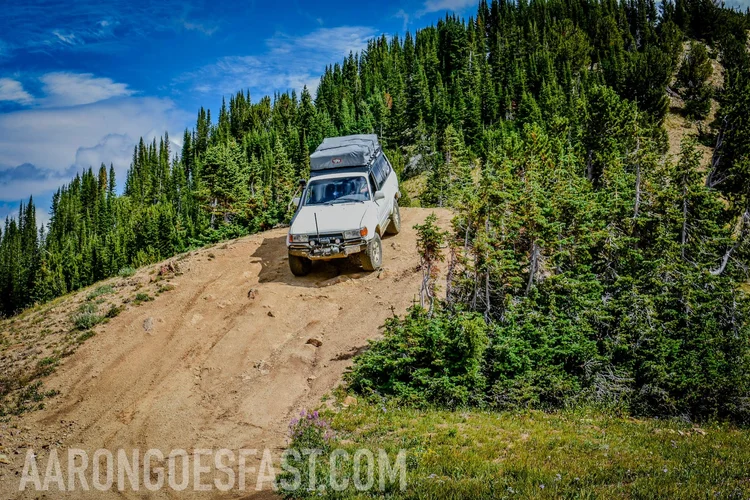
Straight pulls, snatch blocks, redirects and bridles, kinetic ropes, line of fire, and when to walk away. Seen from above.
Cooke City, 2026. Get the rigging right before the pull, not during it.
1. Straight pull
Pull straight in the direction the rig needs to move. An angled pull stacks rope at one end of the drum.
Pick an anchor far enough away that you're pulling from the lower layers of rope, where the winch is strongest.
Strap the anchor with a tree saver as low on the trunk as you can. Hook the winch to the strap with a shackle, hook opening facing up.
Hang a damper (a winch damper, heavy jacket or pack) on the middle of the line so a broken line drops instead of flying.
2. Double line with a snatch block
About 2× the pullHalf the line speedTwice the rope out
Run the line out to a snatch block on the anchor and back to a rated recovery point on the stuck rig. The rig now feels roughly twice the winch's pull.
The anchor carries the full load (both legs), so strap and shackle it for that.
More rope off the drum also puts you on a stronger layer, so a double line often helps more than you'd expect.
3. Redirect around a corner
A block on a second anchor lets you pull from a direction your rig can't drive to. The line pulls on the block from both sides, so the block, its shackle and its strap carry more than the line does.
Load on the block = 2 × line tension × sin(turn ÷ 2). A 90° turn puts about 1.4× the line tension on the block. A 180° turn (a double line) puts 2× on it.
4. Bridle between two anchors
Use a bridle when no single anchor is strong enough. Each leg carries part of the pull, but the wider the angle between the legs, the more each leg carries.
At 120° each leg carries the full pull, so you've gained nothing. Keep it tight: long straps, anchors close together.
5. Kinetic rope vs. tow strap
Kinetic rope or snatch strap
Tow strap
Stretch
About 20 to 30 percent. It stores energy and gives the stuck rig a hard tug.
Little or none. A steady, controlled pull.
Use it for
Short pulls to pop a stuck rig loose.
Steady pulls on flat ground and towing a dead rig home.
Don't use it for
Towing. It stretches too much to control.
Yanking a stuck rig. With no stretch, the shock goes straight into the recovery points.
Size a kinetic rope to the lighter rig. Its minimum breaking strength should be 2 to 3 times that vehicle's gross weight. Too strong a rope won't stretch on a light rig and slams the recovery points instead.
Wet straps are weaker. ARB says a strap can lose up to 20 percent of its strength when wet.
No hooks, no hitch balls, and never join two straps with a steel shackle. A broken hook, ball or shackle flies like a bullet.
Leave some slack and start slow. If a couple of tries don't move it, switch to a winch instead of adding speed.
6. Line of fire
Everyone not needed stays at least 1.5 times the unstretched strap or line length away, off to the side, never in line with the pull.
Only the drivers stay in the rigs. Nobody stands in the path of the pulling rig.
Drape a damper over the middle third of the strap or line.
7. When not to recover
No rated recovery points. A hitch ball or tie-down loop isn't one. Fix that first, or don't pull.
Missing gear. No damper, no rated shackles, the wrong strap. Never attempt a recovery without everything you need.
Buried in mud. Don't snatch a rig that's bogged to the frame. Dig it out and winch it.
The snatch isn't working. More speed and more jerking breaks recovery points, frames and drivetrains. Change to a winch.
It could roll or slide. On a side slope or a ledge, stop. Get experienced help before anything goes under load.
Gloves on before you touch the rope. Keep fingers away from the hook and fairlead when spooling in, and use the hook strap.
Winching rig: engine running, transmission in neutral, brake on. Take up slack gently; jerking the switch shock-loads everything.
Steel shackles: thread the pin in hand tight, then back it off a quarter turn so you can get it out afterward. Soft or steel, know the working load limit and make it suit your rig.
Let the motor rest on long pulls. Stop if the rope piles up at one side of the drum or gets near the tie rods or mounting plate.
Rewind under light tension in even layers.
Never:
Hook to a hitch ball or a tie-down point. Use rated recovery points only.
Step over a line that could come under tension.
Stand in the line's path or between the rigs during a pull.