Which roads are even open, what to check before you leave, how to drive snow, what to do when you're stuck and cold, and where avalanches cross the road.
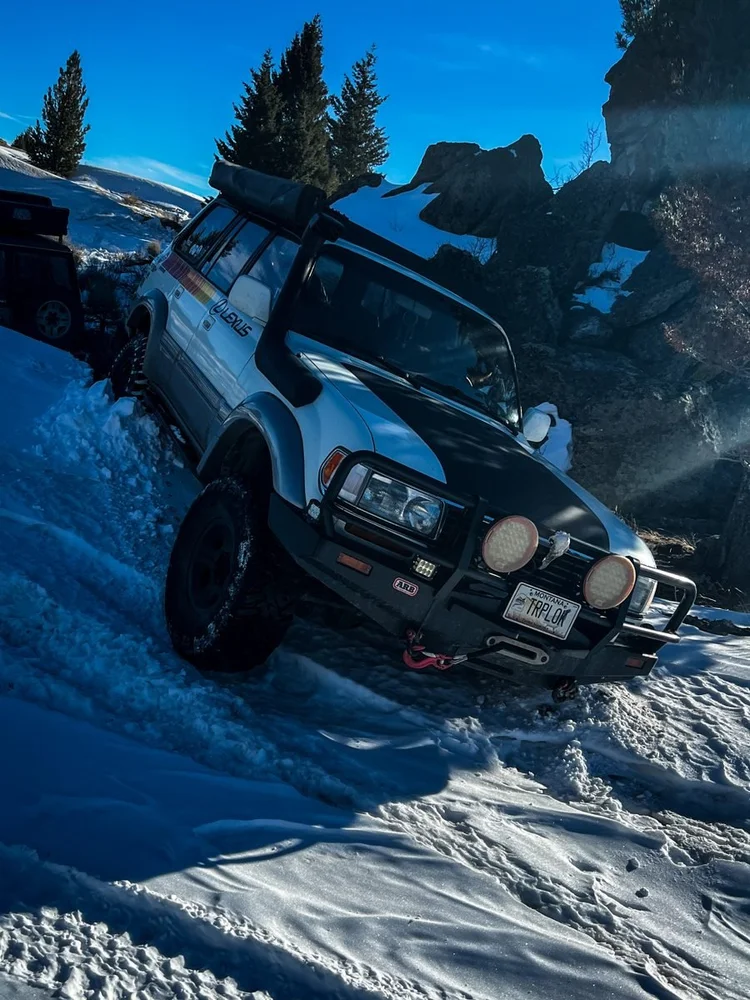
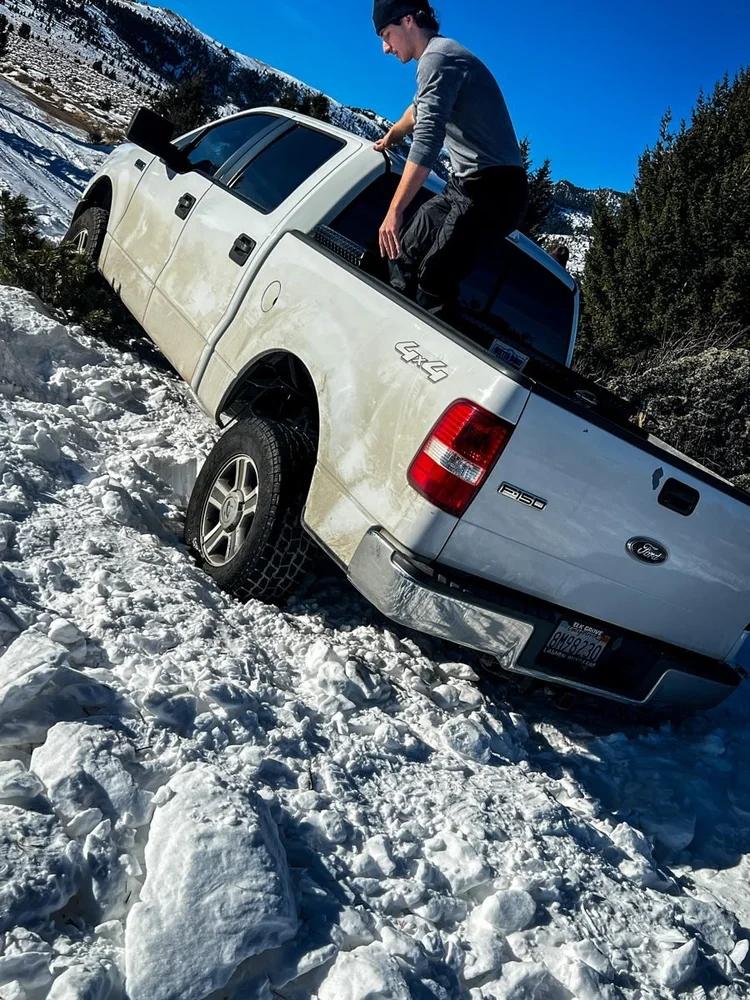
TRPLOK, February 2023. Off-camber, in deep snow, sun already low.Same trip: the F-150 found the ditch. Two rigs is the plan for exactly this.
Answer honestly. One red answer means don't go. Yellow means fix it or change the plan.
These cutoffs are AGF judgment, not a rule from any agency. The road and avalanche answers are the ones that come straight from official sources.
Is the road even open?
The MVUM decides, not the snow. Many forest roads close to wheeled vehicles on a set date each year and stay closed until spring, even if they look drivable. The dates are printed next to each road on the Motor Vehicle Use Map.
Winter roads become snowmobile trails. Roads closed to wheeled vehicles in winter are often groomed for snowmobiles and shown on the Over-Snow Vehicle Use Map. Driving a truck on them wrecks the grooming and puts you head-on with sleds.
It's a federal violation. A driver stuck on a closed, groomed road near Seeley Lake faced a possible Class B misdemeanor, up to a $5,000 fine and six months in jail.
Don't go around a gate. Gates are how a seasonal closure is posted. A gate that's open on the way in can be closed on the way out.
Spring openings slip. Roads with an April or May opening date can stay closed late when snow hangs on. The Forest Service opens them "as soon as conditions permit."
Cooke City in winter: the only road open to regular vehicles is from the North Entrance at Gardiner, through Yellowstone, to Cooke City. The Beartooth Highway is closed from mid-October until the Friday of Memorial Day weekend, and the 9 miles from Cooke City to Pilot Creek are over-snow only (NPS).
Highway rules
Chains: when MDT turns on a chain requirement, every vehicle towing a trailer must chain the drive wheels of one axle. AutoSocks count. Signs with flashing beacons mean the rule is in effect.
Carrying chains: October 1 to April 30, towing units rated 26,001 lb or more must carry chains in designated areas. Four-wheel-drive vehicles are exempt from that carry rule.
Studded tires are legal in Montana from October 1 to May 31.
Chains can be required at about 30 designated spots, including Homestake Pass on I-90, MacDonald Pass on US-12 and Evaro Hill on US-93.
Driving snow
Keep steady momentum. If you have to stop, stop on level ground or pointed downhill. Stopping on a climb is how you get stuck.
Lock it before you're stuck. Engage lockers and any snow mode before you hit the deep stuff, not after you've dug in.
Air down, then air up. Lower pressure floats on snow much like sand. Plan it with the air-down planner and carry a compressor for the pavement.
Pick fresh snow over icy ruts when you can. Use light throttle and leave a long gap to the rig ahead.
Turn around early. Every mile in is a mile you have to drive back out in worse light and colder snow. Turn around while it's still easy.
High-centered? Stop spinning. Dig the snow out from under the frame and axles, not just around the tires, then back out the way you came.
Stuck and cold
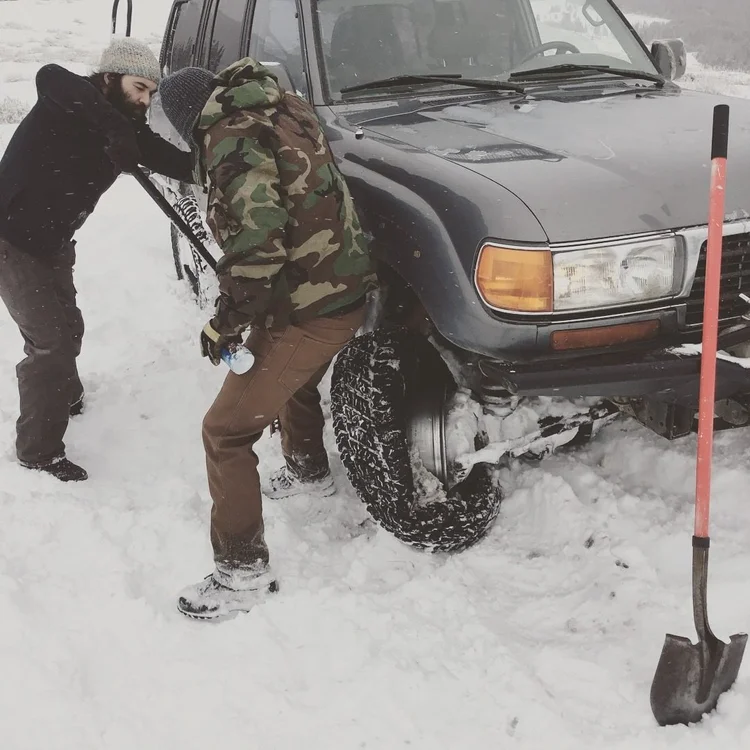
Digging out, December 2017. Keep the shovel where you can reach it without unloading the truck.
Stay with the rig unless shelter is in sight. It's warmer than outside and far easier for rescuers to spot than a person walking.
Run the engine 5 to 10 minutes an hour, with a window cracked. Check that the tailpipe is clear of snow first, and keep checking.
Be seen. Hazards on, something bright on the antenna or window. At night, dome light on, headlights off.
Don't sweat. Digging hard soaks your clothes, and wet clothes are what make you cold. Pace it.
To rock it free: clear 2 to 3 feet in front of the drive wheels, wheels straight, traction control off, rock gently between drive and reverse. Sand or kitty litter under the tires helps.
Call or text 911. If calls won't connect, a text sometimes will. Turn off data and plug the phone in. For no signal at all, see Backcountry emergency.
Carbon monoxide: severe headache, dizziness, nausea, shortness of breath or weakness in a running rig means get to fresh air now. Hypothermia: shivering, exhaustion, confusion, fumbling hands, memory loss, slurred speech or drowsiness means get medical help right away (CDC).
Avalanches cross roads
You don't have to be skiing to be in avalanche terrain. A road under a steep open slope is in the runout. Check the forecast for any route that passes under slopes of about 30 degrees or steeper.
1 LowGenerally safe. Watch for unstable snow on isolated features.
2 ModerateHeightened danger on specific terrain. Know which slopes are the concern.
4 HighVery dangerous. Travel in avalanche terrain is not recommended.
5 ExtremeAvoid all avalanche terrain.
Biggest warning sign: recent avalanches. New snow piling up is the next one, and cracks running through the snow mean the slope is unstable.
If you'll be out of the rig in avalanche terrain, everyone carries a beacon, a metal shovel and a probe, and knows how to use them. Take a class with a field day.
One at a time across or under a suspect slope. Everyone else watches from a safe spot.
Winter carry list
On top of your normal recovery kit. Ticks are saved on this device.